Prayer to the Logos
— Constructed from Ambigua
O Christ, Logos of God, unite all things in Yourself and draw us into divine communion.
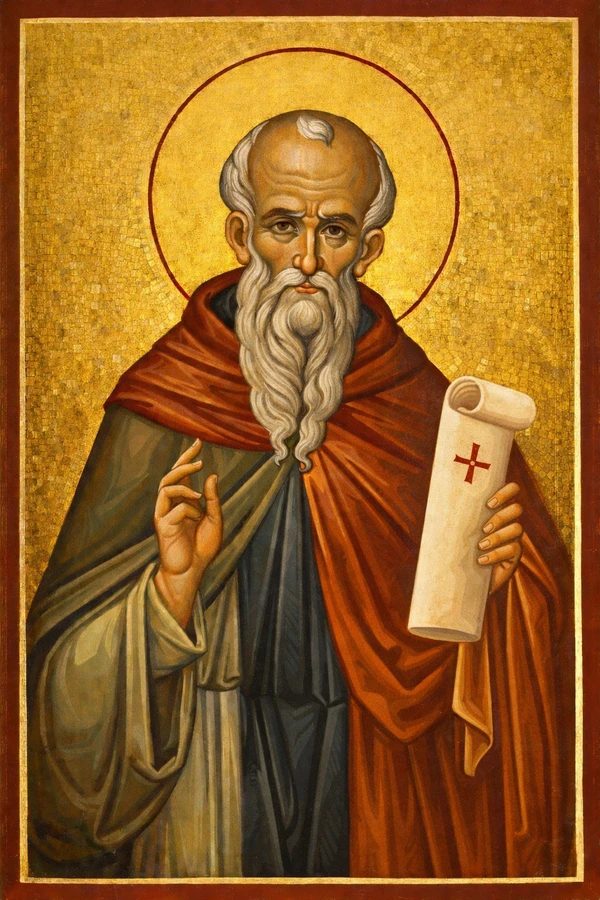
Maximus the Confessor
Biography, major works, and key teachings
Maximus the Confessor was a Byzantine monk-theologian who produced the most comprehensive synthesis of Christology, cosmology, and mystical theology in the Eastern Christian tradition — and paid for his convictions with his tongue and his right hand.
Biography
About
Maximus the Confessor was a Byzantine monk-theologian who produced the most comprehensive synthesis of Christology, cosmology, and mystical theology in the Eastern Christian tradition — and paid for his convictions with his tongue and his right hand.
Life
Born around 580, likely in Constantinople, Maximus served as a secretary in the imperial court before abandoning public life for the monastery. When the Persian and then Arab invasions disrupted the Eastern empire, he moved westward, eventually settling in North Africa and then Rome. There he became the leading theological opponent of Monothelitism — the imperially backed doctrine that Christ possessed only one will. Maximus insisted that Christ must have two wills, divine and human, operating in harmony within one Person, because a human nature without a genuine human will would be incomplete, and what is not fully assumed cannot be healed. For this he was arrested, tried, and, when he refused to recant, had his tongue cut out and his right hand severed — the instruments of his speech and his writing — before being exiled to the Caucasus, where he died in 662. The Third Council of Constantinople vindicated his theology in 681.
Theological Vision
Maximus's vision is breathtaking in scope. He saw the Logos — the divine Word — as the hidden principle embedded in all created things. Every creature contains a logos, a divine reason or intention, that draws it toward its fulfillment in Christ. Creation is not a static fact but a dynamic movement toward divine communion, and the Incarnation is the event in which this movement reaches its climax: God enters creation so that creation might enter God. This is theosis — divinization — and for Maximus it is the destiny not just of human beings but of the entire cosmos. His Ambigua, a series of theological reflections of extraordinary density, works out this vision in dialogue with Gregory of Nazianzen and Pseudo-Dionysius. His Mystagogia reads the liturgy itself as a cosmic symbol of this movement — the church building, the procession of the faithful, the Eucharist all enact the journey of creation into God.
Influence
Maximus is arguably the most important theologian of the first millennium after the New Testament authors. His Christology completed the work of Chalcedon. His cosmology of the logoi gave Christianity its most fully developed theology of creation. His account of theosis became the spiritual backbone of Eastern Orthodoxy. And his willingness to suffer mutilation rather than compromise on the full humanity of Christ stands as one of the most dramatic acts of theological witness in Christian history.
Major Works
The most intellectually ambitious work in the Eastern Christian tradition — Maximus the Confessor's attempt to resolve 'difficult passages' in Gregory of Nazianzen and Pseudo-Dionysius that becomes, in practice, a comprehensive theology of everything. The Ambigua articulates Maximus's vision of the logoi — the divine reasons or intentions embedded in every created thing — all of which find their source and fulfillment in the Logos, Christ. Creation is not a static fact but a movement toward divine communion; the Incarnation is the event in which God enters this movement from within. The work is dense and demanding, but its underlying vision is luminous: every creature is a word spoken by God, and the whole cosmos is a sentence whose meaning is Christ. For readers coming from the saint pages on this site, the Ambigua is where Maximus's theology — hinted at in the quotes and biography — unfolds in its full scope.
Maximus reads the liturgy as a symbol of the cosmos, and the cosmos as a liturgy. In the Mystagogia, the church building represents both the universe and the human soul; the procession of the faithful enacts creation's movement toward God; the Eucharist is the moment where that movement reaches its fulfillment. This is not allegory in the decorative sense — Maximus believes the liturgy genuinely participates in the realities it signifies. The work is shorter and more accessible than the Ambigua, and it offers the best single entry point into Maximus's theology for readers unfamiliar with the Byzantine tradition. If the Ambigua is his summa, the Mystagogia is his invitation.
Responses to sixty-five difficult scriptural passages, weaving together exegesis and Maximus's theology of the Logos, creation, and deification.
Four hundred short reflections on love, organized in groups of one hundred — a genre the Eastern tradition calls 'centuries.' Maximus moves between practical counsel and philosophical depth, sometimes in the space of a single sentence. The early chapters address the passions and their purification; the later chapters open onto the cosmic vision of love as the force that draws all creation toward God. The format makes this the most approachable of Maximus's works — each reflection is self-contained, and many are striking enough to stop a reader mid-page. For those encountering Maximus through the quotes on this site, the Centuries is the natural next step.
Quotes
Selected passages drawn from the writings of Maximus the Confessor.
The Word of God, very God, wills always and in all things to accomplish the mystery of His embodiment.
Ambigua — PG 91:1084
The one who loves God cannot help but love every human being as himself.
Four Hundred Texts on Love — I.13
God and man are paradigms of one another.
Ambigua — PG 91:1113C
The Logos of God is hidden in all things.
Ambigua — PG 91:1085
He who knows the mystery of the cross and the tomb knows the reasons of all things.
Ambigua — PG 91:1360
Love alone is able to bring the activity of the human person into harmony with the principle of nature.
Four Hundred Texts on Love — III.71
The whole universe is a burning bush of divine energies.
Ambigua — Ambigua 10 (adapted)